
Put simply, too many universities across the UK possess world-class research facilities which are not realising their potential as reliable, revenue generating service centres.
At a time when universities are under relentless pressure to diversify income, opening up research facilities to external paying clients is an attractive option.
However, this rarely happens consistently.
Surely, if excellent facilities are on offer, a service fit for purpose will naturally evolve as private sector clients come calling? The old ‘if we build it, they will come’ mentality. Sadly, this is not the case. The bottom line is that excellent facility capabilities don’t create value alone. External customers are not just buying access to equipment. They are buying outcomes, reliability, and confidence that the service will deliver what they need in a professional and predictable way.
What holds back the latent potential of facilities?
It’s no surprise that this situation exists.
Most facilities were never conceived with an external service provision in mind, but as ‘research-only’ internally facing departments. The priority has rightly been on the development of scientific excellence, specialist infrastructure, and academic credibility.
Funding growth has been focused on ad-hoc grant applications rather than a longer-term sustainable model. Again, there is a very good reason for this when we look at the roles involved and the challenges they face:
- Heads of labs/PIs are overloaded with running the lab, writing grants, supervising people and keeping the facility functioning, leaving no capacity to design and run a fully functioning service.
- Technology Transfer Offices (TTOs) see opportunity across university facilities but are also overloaded and lack the time to drive through a service business case.
- University leadership sees potential revenue but mainly risk when asked to dedicate precious investment to developing a service without a robust plan.
- Potential industry clients use facilities on an ad-hoc basis but find it hard to proceed with clunky contracting processes and a lack of a defined service offering.
Some quick fixes may seem attractive at first. Enhancing the facility’s ‘shop window’ is often assumed will lead to organic growth of a service over time. Having access to the right equipment matters. In some cases, a customer is actively looking for a specific tool, platform or technical capability, which can be made clearly visible on a website or service page. Therefore, fixing the external marketing messaging often seems a good place to start. Sadly, these efforts usually set universities up for failure.
Fundamental questions must first be addressed, such as:
- Has the value of the facility’s capabilities been clearly defined in terms of how they solve customers’ problems?
- Has demand been validated at an early stage by speaking to target customers, understanding purchasing drivers, and testing willingness to pay?
- Have resources been allocated, adding a broader set of professional roles to support the service?
- Have clear workflows, defined standards, appropriate quality control and customer journeys been agreed?
If universities want facilities and expertise to become a more reliable source of revenue, they need to be more deliberate about how those services are designed, positioned and operated.
Where will you start?
Arguably, the most critical element which must be addressed is internal alignment. Nothing sticks unless internal stakeholders are aligned and the investment case is explicit and credible.
Here is a top-level six-phase plan:
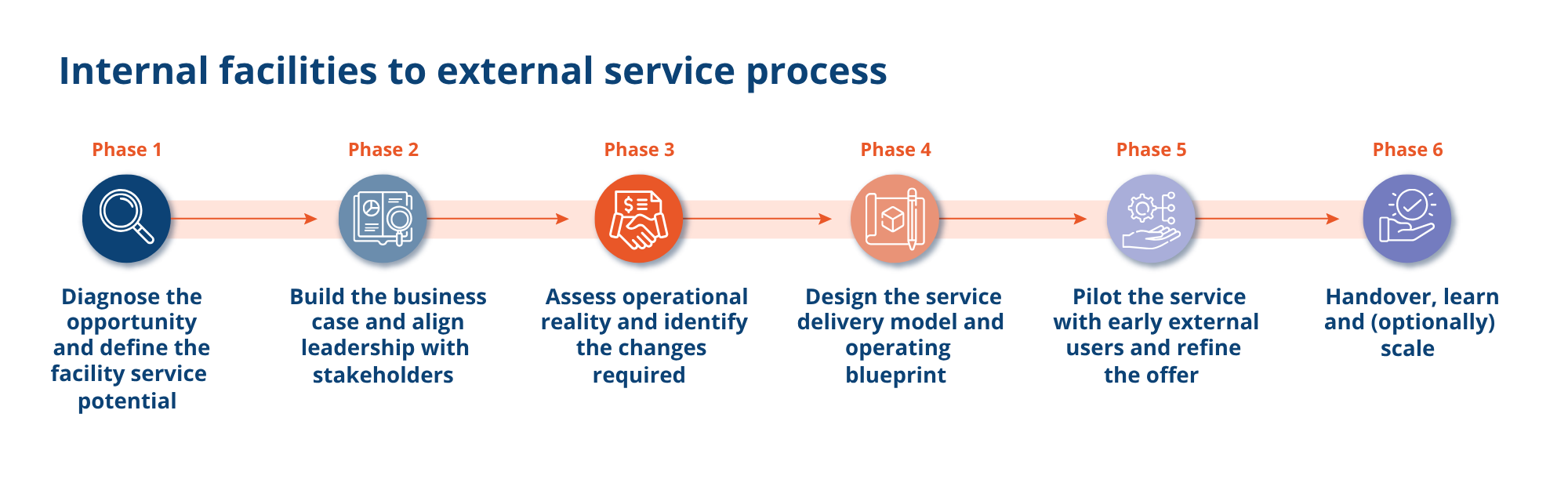
Why this approach?
The challenge is turning capability into a service that customers understand, trust and buy repeatedly. That means working across several issues at once: understanding market demand, defining a clear offer, setting a viable pricing model, putting the right operating structure in place, and making sure delivery is consistent and professional.
As noted, university staff don’t have the time to get this project off the ground, which means the need for an external catalyst.
Each university and facility will have its own challenges, opportunities, resources and constraints, so a catalyst project needs to be tailored. That’s where targeted experience and expertise can deliver the most value.
Worth discussing further?
We’ve successfully carried out this work for multiple universities, and are ready to discuss your needs. Contact Bruno Reynolds for an initial scoping discussion.