
By Dr Frank Wong
While we started interrogating how to value early-stage SHAPE ventures, we realised that the problem is SHAPE ventures usually self-fund until initial market traction is demonstrated.
At Oxentia, we have been reflecting on the gap in early-stage SHAPE venture valuation methodologies. We found that early-stage startup valuation tools, such as the Berkus Method1 or the Scorecard Method2, had simply not been adapted for SHAPE. However, when we researched further, what we found was that the early-stage SHAPE venture fundraising challenge is not about the lack of a SHAPE valuation tool, but actually is about the investment readiness of SHAPE ventures.
It is not that early-stage SHAPE ventures cannot be valued before they have customers. It is that nobody expects them to be.
Based on our experience, most SHAPE ventures adopt a service/software based business model, and they are typically capital-light to set up. A working version of a software or service model can usually be built on founder time with modest resources.3, 4 Unlike biotech or hardware ventures, SHAPE ventures usually do not need expensive equipment or years of translational R&D before they can sell in the market. In addition, standard start-up advice for capital-light ventures is to bootstrap towards real traction, paying customers, live pilots, a genuine user base, before raising external money to scale up. This also gives the SHAPE venture a position of strength to negotiate investment offers once that traction exists. Therefore, not raising SHAPE venture investment pre-traction is not a market gap, it is arguably a sensible fundraising strategy: why give away more equity pre-traction, while you could likely build the traction yourself with limited capital.
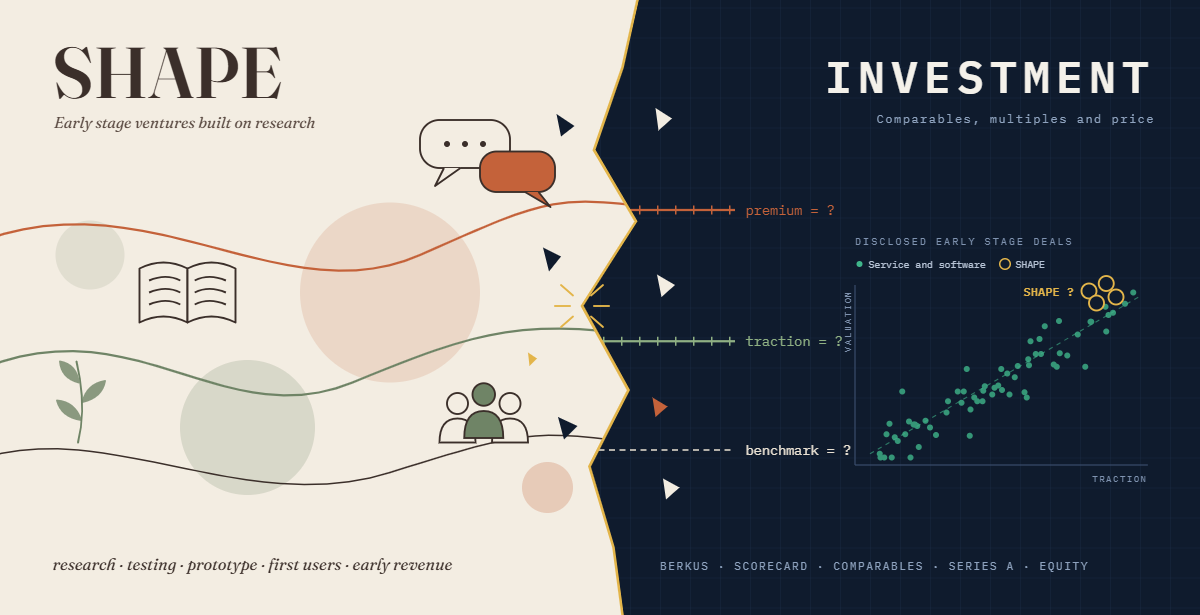
Hence, the pre-traction stage fundraising was not the missing piece. The gap exists a step later. Once a SHAPE founder has done exactly what the market asked, built a prototype, user base, and earned early revenue/sales, how much traction is a sweet spot for fundraising? At that point, a SaaS founder walks into the negotiation room backed by a well-populated pool of comparable deals. This includes thousands of disclosed raises and multiples that allow both the founder and investors to comfortably benchmark their venture against the market price. A SHAPE founder with a comparable level of traction has almost none of that. Disclosed early-stage SHAPE deals are extremely rare to the point there is barely a market to benchmark against, whichever valuation method an investor reaches for.
Could SHAPE venture raise investment at a premium
When a SHAPE venture achieves enough traction, it is likely an investor reaches for the nearest substitute, pricing a SHAPE venture the way they would price any other early-stage service or software business. The question is: backed by years of academic research, testing and refinement, could a SHAPE venture raise investment at a premium (higher value per share) compared to a service/software business with similar traction?
It is worth separating two things here. SHAPE ventures are usually not patent-protected, as most SHAPE research does not qualify for the patenting criteria. Unlike the biotech and engineering spin-outs, which usually leverage a patent to assert a monopoly to investors, should the technology be successfully developed. There is a related question about whether SHAPE’s IP output could be licensed out earlier in a venture’s life, closer to how STEM patents often are to create both income and a real price point along the way. Oxentia is researching this thread and will update our summary in the next article.
However, the premium question is separate: does the research itself, the years spent testing and refining the model, tell you anything about whether this venture solves a real problem for a paying market? Does the research behind the SHAPE venture help to derisk the investment?
The good news: this gap has an edge to it
None of this suggests SHAPE ventures are unpriceable, and that is the part worth being optimistic about. Once a venture has real revenue or a genuine customer base, the ordinary tools work again. Gravity Sketch is a design tool venture that grew out of a joint Royal College of Art and Imperial College London programme. They raised a successful £25 million Series A once it had established commercial traction with customers such as Ford, Nissan, Volkswagen, New Balance, and Adidas.5
The problem is then less about SHAPE ventures sitting outside the reach of normal valuation. It is more about how much traction a SHAPE venture needs to demonstrate to be investable.
Two questions worth answering
Where is the bootstrap-to-traction threshold? If bootstrapping (self-funding) to traction is the right approach for SHAPE founders, and we think it often is, how much traction is actually enough? Also, how does that threshold differ across a research-led consultancy, a SHAPE-based software product, or a policy-facing venture? Right now, the honest answer is ‘as long as it takes’, which is not something a founder can plan around or an investor can benchmark against.
Does research pedigree deserve a premium? And if a venture’s years of academic grounding are worth something at valuation? What due diligence does the investor need to perform on the research outcomes? How do we assess the strength of the underlying problem-solution match, for the premium to actually hold up?
For now, we think the more useful contribution is naming the gap precisely: not ‘SHAPE is hard to value’, but the SHAPE fundraising journey where the tools investors already trust simply have not had enough SHAPE deals to learn from yet.
We would be glad to hear from anyone: founder, investor, or TTO who has raised investment with a SHAPE venture. We are keen to collect more data points to add the necessary transparency to the SHAPE VC investment space.
References:
- Berkus, D. (2016). The Berkus method: Valuing an early-stage investment. Berkus.com.
- Baurek-Karlic, B. (2020, April 3). Pre-revenue startup valuation: The Payne scorecard method. Venionaire Capital.
- Mac an Bhaird, C., & Lynn, T. (2015). Seeding the cloud: Financial bootstrapping in the computer software sector. Venture Capital, 17(1–2), 151–170.
- Serrasqueiro, Z., Armada, M. R., & Nunes, P. M. (2011). Pecking order theory versus trade-off theory: Are service SMEs’ capital structure decisions different? Service Business, 5(4), 381–409.
- Wilson, J., Tooze, J., Duncan, C., & Johns, S. (2023, June 8). Celebrating Imperial’s international graduates. Imperial College London.