
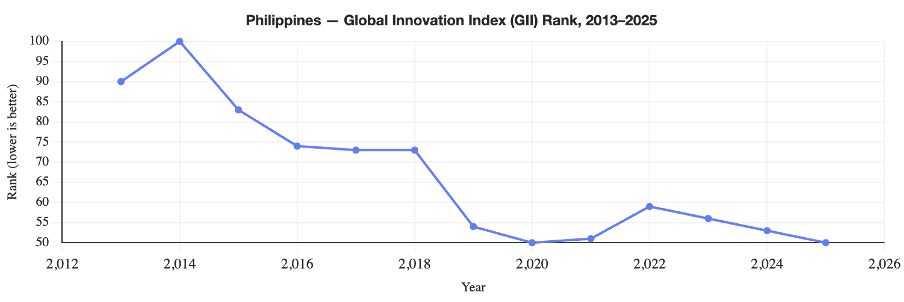
The Philippines’ innovation ecosystem is at a crossroads. Since 2013, often cited as the baseline year for the country’s knowledge economy growth, the Philippines has climbed over 40 places in the Global Innovation Index, and the country’s knowledge output, measured via proxy indicator (number of patents filed) has also steadily increased.
Yet, many gaps in Policy remain. The foundational Technology Transfer Act of 2009, followed by the Innovative Startup Act and the Philippine Innovation Act of 2019, have set the starting point for growth and development. However, cumbersome government interventionism, lack of professionalisation, and misaligned incentive mechanisms still hold the ecosystem back.
In 2025, Oxentia was commissioned by the Department of Science and Technology (DOST) through the British Council Manila to undertake a review of existing national policy related to innovation and commercialisation, and to draft a new policy framework to guide policymakers in the short term. The policy framework, published through Administrative Order in March 2026, focusses on the following pillars:
- A System‑wide, unified approach to tech transfer, establishing common principles, definitions, and operating norms
- Clear institutional roles and governance between DOST, RDIs, TTO and the wider higher education, research, and STI stakeholders.
- Capacity building as a policy pillar, focussing on skills development and professionalisation of TTOs as a policy issue.
- Alignment of incentives and benefit‑sharing alignment, including commercialisation outcomes as a career driver for researchers.
Two salient gaps remain:
- A unified set of tools that empower TTOs and support organisations to evaluate innovations in a market context, and understand the monetary value of technology from early in the commercialisation journey.
- Access to a verified, trusted, national testing platform, to de-risk technologies at medium-to-high TRLs and connect knowledge generators with industry partners
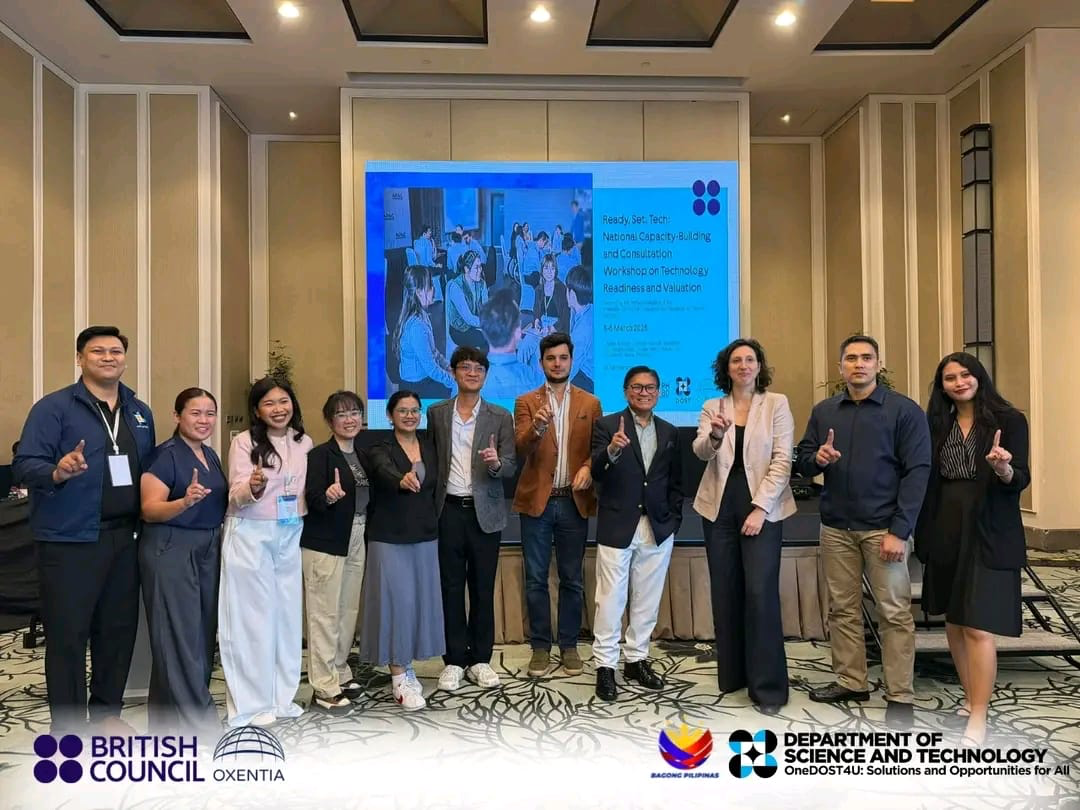
In early March 2026, Oxentia delivered two days of national capacity building workshops, presenting and training users on two toolkits – a national Market Readiness Level assessment toolkit, and a national Technology Valuation toolkit. The audience was made up on Technology Transfer Officers, DOST officers, innovators, investors and the newly recruited team of PHI-TEST Master Trainers.
So what is PHI-TEST? Operating under the motto “Proven in the Philippines, Trusted by the World” PHI-TEST is a flagship collaboration between the Department of Science and Technology (DOST) and the Commission on Higher Education (CHED), and it will provide a systematic process for technologies developed in the Philippines to receive a “seal of approval”, demonstrating innovation quality and market readiness. Through rigorous large-scale national testing, new technologies will complete the PHI-TEST process with large-scale user validation in real-market settings, building market trust at scale before marketing technologies on a global scale.
Oxentia’s work in the Philippines, funded by the British Council under the International Science Partnerships Fund (ISPF) will continue, supporting DOST and CHED in the development and implementation of PHI-TEST, ensuring that the UK is positioned as the key strategic partner for the development of the Philippines’ innovation ecosystem.